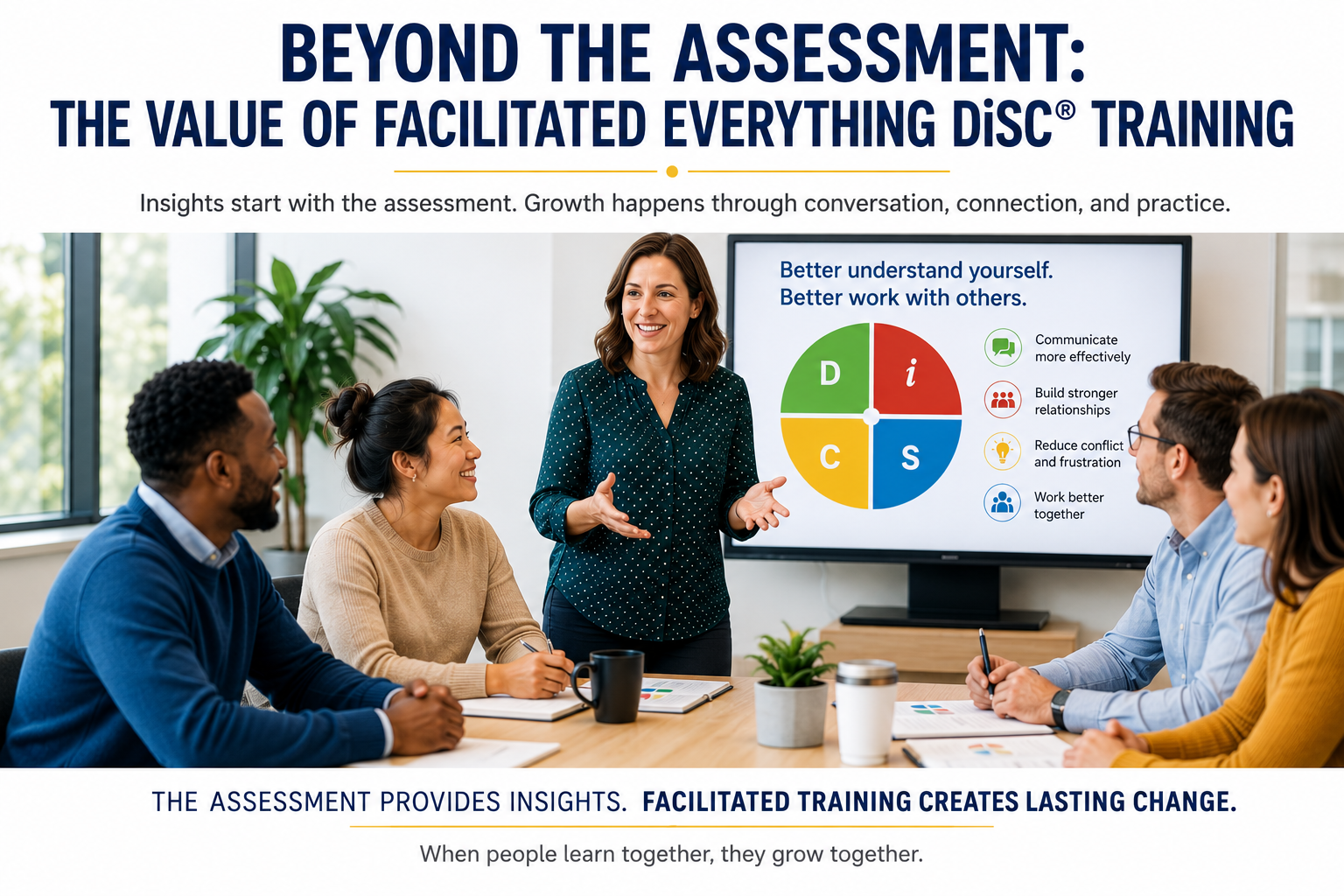
Why Everything DiSC® Training Is More Than a Personality Assessment
Completing an Everything DiSC® Workplace assessment is an excellent first step toward improving workplace communication, collaboration, and self-awareness. The personalized report provides valuable insights into an individual’s behavioral style, priorities, motivators, and tendencies.
However, while the assessment delivers meaningful information, reading a report alone rarely creates lasting behavioral change.
Many participants review their results, recognize a few strengths and challenges, and then return to their daily routines. Without guided discussion and practical application, the insights often remain interesting observations rather than becoming tools for improving workplace relationships and performance.
This is where facilitated Everything DiSC training provides significant value.
Turning DiSC Insights into Real-World Application
A skilled facilitator helps participants move beyond simply understanding their own DiSC style to learning how to apply that knowledge in everyday workplace situations.
Through interactive discussions, hands-on activities, and collaborative exercises, participants gain a deeper understanding of how different behavioral styles:
- Communicate and share information
- Make decisions
- Respond to challenges and change
- Handle conflict
- Build trust and relationships
- Approach tasks and teamwork
Rather than focusing solely on individual results, facilitated training helps employees connect DiSC concepts directly to their daily interactions and workplace responsibilities.
Strengthening Team Communication and Collaboration
One of the greatest benefits of facilitated DiSC training is the opportunity for team members to learn about one another.
Instead of simply reading about style differences, participants engage in meaningful conversations that foster understanding, empathy, and respect. Team members begin to recognize why colleagues may approach work differently and how those differences can become strengths rather than sources of frustration.
These shared learning experiences help teams:
- Improve workplace communication
- Reduce misunderstandings
- Increase collaboration
- Strengthen trust
- Develop more productive working relationships
As employees gain a better understanding of one another, teams become more connected and effective.
Solving Workplace Challenges Through Team Development
Organizations often invest in Everything DiSC because they want to address common workplace challenges such as:
- Poor communication
- Workplace conflict
- Low employee engagement
- Siloed departments
- Ineffective teamwork
- Leadership communication gaps
While self-awareness is an important starting point, these challenges are rarely solved by individual insight alone.
Real improvement occurs when teams learn together, practice new skills, and commit to changing how they communicate and collaborate. Facilitated training creates a shared language that employees can use long after the workshop ends, helping reinforce positive behaviors and sustain growth.
Why Facilitated DiSC Training Creates Lasting Results
The Everything DiSC Workplace assessment provides the insights. Facilitated training transforms those insights into action.
When organizations combine the assessment with a professionally facilitated learning experience, employees gain more than self-awareness—they develop practical skills that improve communication, strengthen relationships, and enhance team performance.
The result is a workplace where people understand themselves better, work more effectively with others, and contribute to a stronger organizational culture.
Investing in Long-Term Workplace Success
Everything DiSC is most powerful when it becomes more than a report—it becomes part of how people communicate, collaborate, and lead.
By pairing the Everything DiSC Workplace assessment with facilitated training, organizations create a foundation for stronger communication, healthier workplace relationships, improved employee engagement, and more effective teams.
For organizations looking to maximize their investment in DiSC, facilitated training is not an optional add-on—it is the bridge between awareness and lasting workplace transformation.
 Every thriving organization relies on honest feedback. For leaders, input is crucial not only from their bosses, but also from subordinates and colleagues. To solicit input, many organizations use 360-degree performance feedback profiles. However, with the way these assessments are structured, the comments can sting—and even cause damage to morale. Fortunately, there’s a better way. Let us explain.