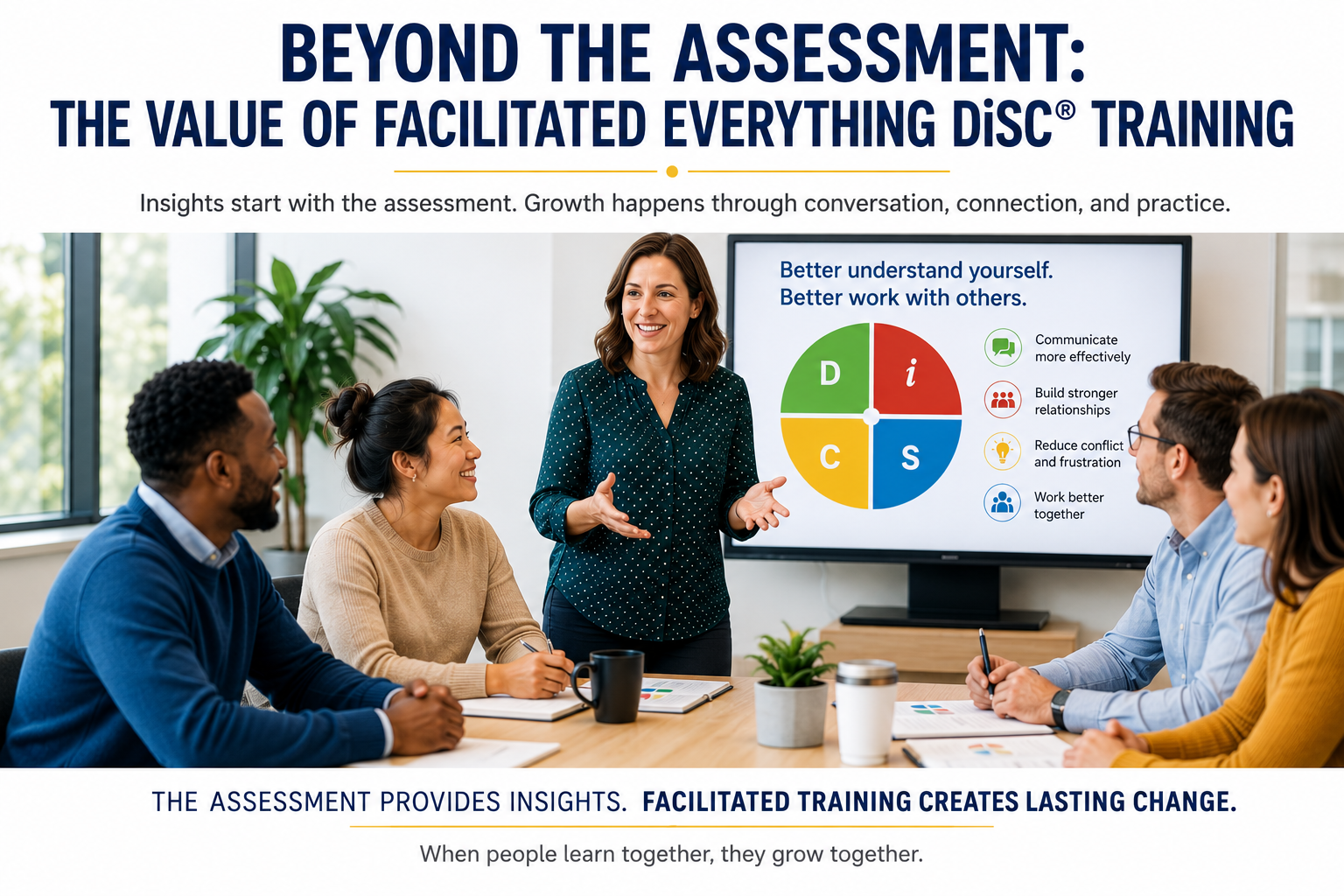
Beyond the Assessment: The Value of Facilitated Everything DiSC Training

The Value of Facilitated DiSC Training

Why Everything DiSC® Training Is More Than a Personality Assessment

Completing an Everything DiSC® Workplace assessment is an excellent first step toward improving workplace communication, collaboration, and self-awareness. The personalized report provides valuable insights into an individual’s behavioral style, priorities, motivators, and tendencies.

However, while the assessment delivers meaningful information, reading a report alone rarely creates lasting behavioral change.

Many participants review their results, recognize a few strengths and challenges, and then return to their daily routines. Without guided discussion and practical application, the insights often remain interesting observations rather than becoming tools for improving workplace relationships and performance.

This is where facilitated Everything DiSC training provides significant value.

Turning DiSC Insights into Real-World Application

A skilled facilitator helps participants move beyond simply understanding their own DiSC style to learning how to apply that knowledge in everyday workplace situations.

Through interactive discussions, hands-on activities, and collaborative exercises, participants gain a deeper understanding of how different behavioral styles:

  • Communicate and share information
  • Make decisions
  • Respond to challenges and change
  • Handle conflict
  • Build trust and relationships
  • Approach tasks and teamwork

Rather than focusing solely on individual results, facilitated training helps employees connect DiSC concepts directly to their daily interactions and workplace responsibilities.

Strengthening Team Communication and Collaboration

One of the greatest benefits of facilitated DiSC training is the opportunity for team members to learn about one another.

Instead of simply reading about style differences, participants engage in meaningful conversations that foster understanding, empathy, and respect. Team members begin to recognize why colleagues may approach work differently and how those differences can become strengths rather than sources of frustration.

These shared learning experiences help teams:

  • Improve workplace communication
  • Reduce misunderstandings
  • Increase collaboration
  • Strengthen trust
  • Develop more productive working relationships

As employees gain a better understanding of one another, teams become more connected and effective.

Solving Workplace Challenges Through Team Development

Organizations often invest in Everything DiSC because they want to address common workplace challenges such as:

  • Poor communication
  • Workplace conflict
  • Low employee engagement
  • Siloed departments
  • Ineffective teamwork
  • Leadership communication gaps

While self-awareness is an important starting point, these challenges are rarely solved by individual insight alone.

Real improvement occurs when teams learn together, practice new skills, and commit to changing how they communicate and collaborate. Facilitated training creates a shared language that employees can use long after the workshop ends, helping reinforce positive behaviors and sustain growth.

Why Facilitated DiSC Training Creates Lasting Results

The Everything DiSC Workplace assessment provides the insights. Facilitated training transforms those insights into action.

When organizations combine the assessment with a professionally facilitated learning experience, employees gain more than self-awareness—they develop practical skills that improve communication, strengthen relationships, and enhance team performance.

The result is a workplace where people understand themselves better, work more effectively with others, and contribute to a stronger organizational culture.

Investing in Long-Term Workplace Success

Everything DiSC is most powerful when it becomes more than a report—it becomes part of how people communicate, collaborate, and lead.

By pairing the Everything DiSC Workplace assessment with facilitated training, organizations create a foundation for stronger communication, healthier workplace relationships, improved employee engagement, and more effective teams.

For organizations looking to maximize their investment in DiSC, facilitated training is not an optional add-on—it is the bridge between awareness and lasting workplace transformation.

Webinar: Maintain Team Momentum During Management Changes

Team Exhibiting MomentumWhether a manager is going to be responsible for a new group because of an internal promotion, a transfer, or company reorganization, they will be challenged with building relationships with their new team members.

On the other hand, when teams face a management change, it taxes their engagement and productivity.

Learn how Everything DiSC Management and Everything DiSC Workplace assessments can help managers understand, relate to and communicate with their new team. And how these tools can help the team work with a new boss.

In this webinar you’ll hear:

  1. Areas of communication most important to management transition and success
  2. How management style can impact a new team
  3. How to recognize and best approach the style of each team member
  4. How to create a motivating team atmosphere

Learn how you can help your managers gain traction quickly with new teams.

Contact us to request the August 29 webinar recording.


Webinar: Discover Three Tools to Shape Your Leaders

Leading TeamsLeaders, even experienced ones, can be caught off guard by management and leadership challenges.

  1. Are your leaders often misunderstood?
  2. Do they forge ahead with solutions when they should be taking time to test assumptions?
  3. How about thinking that everyone is on board with their ideas, when the team is just fearful of speaking up?

During our complimentary webinar, you’ll discover how three tools have helped thousands of emerging and experienced leaders create better results through self-awareness and personal action planning:  Everything DiSC Management and Work of Leaders. You’ll gain insights on:

  • The key attributes and best practices of management and leadership
  • Why gaining feedback is a critical element of leadership development
  • How to layer individual programs for optimum results

Don’t have a current leadership development program? We’ll help you get started.

Date:  May 30, 2018

Contact Us to request the webinar recording.

Learn more about these assessments, request a demo or make a purchase:

Everything DiSC Management

Everything DiSC Work of Leaders

Complimentary Webinar: Everything DiSC Workplace Assessment

Everything DiSC Workplace Webinar Covering Facilitation

Become a Star Facilitator! Join our Everything DiSC Workplace webinar…

Officially titled, Bring Everything DiSC Workplace to Your Team, this webinar will demonstrate the features and benefits of the Everything DiSC Workplace Facilitation Kit. Discover just how easy the facilitation kit makes it to conduct 1-hour to 1-day workshops in this complimentary Everything DiSC Workplace webinar. We will also explore the Everything DiSC Workplace assessment.

In this webinar, you will learn to use the new step-by-step kit and your team’s profile results to build better relationships. Help your team learn to communicate more effectively by:

  • Discovering their DiSC style
  • Understanding other styles
  • Learning to build more effective relationships

You’ll see samples of the PowerPoint slides, exercises and powerful new videos.  We will also demonstration MyEverythingDiSC, the online interactive portal/app that allows your team to compare themselves with coworkers they communicate with daily.

Date:  April 26, 2018

Contact Us to request the webinar recording.

Learn more about Everything DiSC Workplace, request a demo or make a purchase.

Learn about Everything DiSC Productive Conflict: A New Approach to Old Problems

According to Entrepreneur Magazine, the cost of workplace conflict costs US businesses $359 billion per year.

We’ve all contributed to those costs when we engage in destructive disagreements or issues that bubble beneath the surface and don’t go away.

However you think of conflict, it comes down to a difference of opinion involving strong emotions.  Whether it’s a brief, explosive dispute or subtle long-lasting issues, we’ve all done things we’re not proud of.  It’s why the typical manager spends 25-40% of their time dealing with conflict.

It’s not all about following steps in conflict resolution.  It’s about understanding why we do what we do and how to change it.

Join us to explore a new DiSC based assessment – Productive Conflict.  You’ll take away an understanding of:

  1. What drives each of us in conflict.
  2. How to recognize destructive automatic thoughts.
  3. A method of changing responses that have negative consequences.
  4. How to help your team members change their behavior and improve their results.

Date:  February 22, 2018

Contact Us to request the webinar recording.

Learn more about Everything DiSC Productive Conflict, request a demo or make a purchase.

Webinar: Is Change in the New Year Challenging Your Team?

See How Everything DiSC Workplace Helps You Manage Change

Change is the only constant in life.  And many of us are in fast changing environments at work.  Our markets, business climate, culture, employees and customers are shifting rapidly, demanding we change our approach and strategies!  This is not always easy.  Particularly for those who prefer the status quo.

In our complimentary webinar, you’ll learn:

  • The behavioral approaches to change.
  • The reasons for change and the different types of change.
  • How to examine your reactions based on your DiSC behavior style.
  • How Everything DiSC Workplace can help you and your team prepare, accept and embrace change and get started on a personal action plan.

Date:  January 25, 2018

Contact Us to request the webinar recording.

Learn more about Everything DiSC Workplace, request a demo or make a purchase.

Webinar: Productive Conflict – New Approach to Old Problems

According to Entrepreneur Magazine, workplace conflict costs US businesses $359 billion per year.

We’ve all contributed to those costs when we engage in destructive disagreements or issues that bubble beneath the surface and don’t go away.

However you think of conflict, it comes down to a difference of opinion involving strong emotion. Whether it’s a brief, explosive dispute or subtle long-lasting issues, we’ve all done things we’re not proud of.  It’s why the typical manager spends 25-40% of their time dealing with conflict.

It’s not all about following steps in conflict resolution.  It’s about understanding why we do what we do and how to change it.

Join us to explore a new DiSC based assessment – Productive Conflict.  You’ll take away an understanding of:

  • What drives each of us in conflict
  • How to recognize destructive automatic thoughts
  • A method of changing responses that have negative consequences
  • How to help your team members change their behavior and improve their results

Date:  November 16, 2017

Contact Us to request the webinar recording.

Learn more about Everything DiSC Productive Conflict, request a demo or make a purchase.

How DiSC Profiling Empowers Your Team to Work Together

An effective way to maximize the potential of a group of coworkers is to identify their individual personality styles through DiSC profiling and establishing communication about how different dispositions relate to one another.

Members of a successful team must become adept at engaging in healthy conflict, committing to a vision, maintaining trust, becoming personally accountable and following protocols that achieve results.

DiSC training breaks down human personality types into four major distinctions that identify people who have a natural inclination for taking charge and making quick decisions (D style) along with others who are more prone to go along with a plan when a sense of team spirit is found in the workplace (i style).

Similarly, DiSC also identifies people who are careful decision makers and will weigh out all of the variables before committing to a course of action (S style) as well as those individuals whose minds are influenced by objectivity rather than intuition or emotion (C style).

DiSC training then elaborates on how the different personality types can be expected to interact in a work environment that encourages trust, healthy conflict, commitment, accountability and results.

Trust is a Must 

Establishing trust between coworkers requires that people transform two-dimensional relationships into deeper bonds. The DiSC training assessment system helps coworkers understand one another by identifying individual strengths and weaknesses and making all parties privy to that information.

This way, if a “D” type personality is on a team with someone who is a “S,” that first person will know that it is OK for them to take charge of making split-second decisions. Meanwhile, the “S” personality can be delegated to assimilate large quantities of information to determine the long-term scope and direction of a project.

Knowing the strengths and weaknesses of those you work with mean that you can be better trusted to interact with them accordingly.

Creative Tension

Conflict between coworkers can be healthy when it involves two or more people presenting opposing ideas based on their individual expertise. Rather than avoiding confrontation, as most people prefer, coworkers who have built trust tend to embrace a tense situation because it forces people to express themselves.

With DiSC training, after your team members have expressed themselves and listened to opposing opinions, they can then come to a mutually agreeable compromise based on a strategy that will result in goals being met.

This can also be described as a passionate presentation of solutions to problems. Through this process, all are encouraged to share their opinions and propositions so that goals can be identified through the collective knowledge of the group. The saying, “none of us are smarter than all of us” applies to the process of teams becoming more empowered by learning to understand one another’s ideas.

All Aboard

DiSC profiling allows for the efficient alignment of different personality styles once a team directive has been set and goals have been established. This stage of teamwork is possible after healthy conflict has revealed the best way to move forward based on the collective strengths of the team.

For instance, the “D” type personalities may have been ready to choose a course of action immediately, while the “S” individuals insist on gathering more information before committing to a certain path.

Understanding the personalities of your teammates from square one affords you the insight as a “C” personality to know that once you are on board with an idea, the “i” personalities in the group are more likely to commit to a plan.

Accountability

Holding your teammates accountable for their actions, or lack thereof, is an integral part of realizing success as a team. The information provided to you by the DiSC profiling system allows you to tailor your approach to a teammate according to their personality type.

When talking to a “D” person, you’re going to get the best results with a straightforward delivery. Whereas people with an “i” personality are going to respond best to feedback that has something positive to say in order to offset the sting of anything critical in nature that needs to be pointed out.

Meanwhile, if you call out a “S” personality, it’s best to be considerate yet direct. When holding a “C” person accountable you’re going to want to speak in honest, logical terms that validate conclusions with specific, tangible examples.

The Bottom Line

The entire reason behind orchestrating a team effort through DiSC is to render results that are not possible through the work of just one person. Yet, too often team members can get caught up in the details of communicating and the tunnel vision of task-oriented thinking.

As this is occurring, focus on whether or not results are taking place due to the efforts of the team. This may become lost as individuals within a team can purposefully or inadvertently shift their intention from a group-based mindset to selfish thinking.

The collective goals of the team can also be overridden by personal goals for career advancement or desire for individual recognition. This is why the practice of accountability is important as well as using the DiSC profile to help deliver the proper feedback to your team members to keep them on track and create results.

Teamwork is a complicated undertaking because, in order to be successful, people with vastly differing personalities and working styles have to learn how to get along; by learning to trust one another, engaging in healthy conflict, committing holistic vision, being accountable, and maintaining focus on the creation of tangible results.

Contact us at Corexcel to learn more about how the DiSC profiling system of human resource management can create effective teams that produce real results.

Webinar: Overcoming Workplace Negativity, New Tools

Nothing affects employee morale and productivity more insidiously than negativity in the workplace. It is the “noise” that diverts energy and attention from critical initiatives. It is a barrier to positive change, kills morale and blocks productivity. It’s infectious.

In this webinar, we’ll review

  • What causes negativity
  • How you enable negativity
  • What you can do about it
  • Introduce a new tool to help you turn a negative culture into a positive one

Date:  August 31, 2017

Contact Us to request the webinar recording.

Learn more about Everything DiSC Workplace, request a demo or make a purchase.

William Marston: Wonder Woman’s Creator Gave the World DISC

There certainly is a huge buzz about Wonder Woman, the Amazonian princess who is one of the major superheroes in the DC Comics universe. Thanks to actress Gal Gadot, director Patty Jenkins, and scriptwriter Allan Heinberg, she’s now become one of the most successful superheroes to hit the box office.

The Creation Unfolds

When introduced in 1941, Wonder Woman was a rare example of a strong female heroine who didn’t need a man to save her. Later, she came out as bisexual and has become a symbol for both women’s rights and the LGBT community. She’s unique in another way: her creator, William Marston, was not the typical comic book writer or artist.

Unlike the industry hall of fame comic-book writers, Stan Lee and Jack Kirby, William Marston was a psychologist. Marston went to Harvard for his education, graduating in 1921 with a Ph.D. in psychology, followed by teaching positions at both American University and Tufts University. During the 1920s and 1930s, he published a number of different research papers and books, including Emotions of Normal People, where he laid out his theory of human behavior that would eventually be used for DiSC. 

The Beginnings of Wonder Woman

Marston was interviewed in a Family Circle Magazine article where he discussed his belief that comic books could be used for educational purposes. This article brought him to the attention of Max Gaines, a comic book publisher, who hired Marston to serve as an educational consultant for what would become DC Comics.

Marston suggested the company introduce a hero who saved the day with love and compassion rather than by fighting. With his wife Elizabeth’s suggestion, they created a strong female lead character. In a time where women’s rights were challenged, he planted a seed of gender equality and created a symbol of women’s empowerment.

Marston and DiSC Theory

While Wonder Woman may be Marston’s most well known creation, especially among the general public, many psychologists know him more as one of the fathers of DiSC. His interest in this area can be traced back to 1924 when he began looking at concepts of will and power, and how they affected personality and behavior. Four years later, he published Emotions of Normal People and laid out what he believed were the four basic behavior types: Dominance, Inducement, Submission, and Compliance. From these theories of behavior, they eventually came to be adopted and built into the DISC Personality Profile Test.

Marston believed that the basis of all four behaviors had to do with the environment around the person. It all depended on whether they saw their environment as being favorable or as being unfavorable, and if they had control over that environment. In 1931, he elaborated on his theory even more in his book DISC, Integrative Psychology. While Marston didn’t outline the modern DiSC profile or discuss DISC training or DISC testing, all of his work laid the foundation for these tools.

Later, Walter Clarke would take Marston’s ideas and create an assessment tool that could be used to create a profile of a person’s personality.

DISC and Wonder Woman

Marston’s work on DISC is reflected in Wonder Woman, too. Her dominance over her environment, her influence over others, her steadiness when faced with adversity, and her compliance with the laws and morals can all be linked to DiSC theory.

Both Wonder Woman and DiSC can be summed up with one of Marston’s most famous quotes: “Every crisis offers you extra desired power.” With William Marston’s DiSC theory, every crisis gives a person a chance to gain more control over their environment by adapting to a situation or experience or by Influencing the outcome.

Wonder Woman also illustrates this quote in both the comics and in the movie. In the film, her adversary, Ares, appears to be much more powerful than the hero. Then comes a point of crisis: <Spoiler Alert!> trapped, Wonder Woman is forced to watch her friend and love interest Steve Trevor sacrifice himself to destroy a plane full of poison. This gives her the desired power she needs to defeat Ares and save the day.

Why DiSC® is Valuable to Growing Companies

DiSC can be very useful to growing companies and teams by providing ways to effectively handle communication with different personality styles. With miscommunication often being the root of conflict, it can be one of the biggest contributors to lost productivity.

DiSC training can help team leaders solve these issues of miscommunication by creating a more cohesive work environment and enabling each team member to learn how to better communicate, leading the team come to a consensus on decisions more quickly.

How DiSC is a Superpower

DiSC training can turn any facilitator, team leader, or supervisor into a superhero by giving them the tools they need to handle miscommunication or conflict. By using the DiSC assessments, a team leader can better understand each team member and facilitate understanding between team members.

Of course, it’s important to remember that DiSC, like superpowers, can be used for evil, too. The DiSC model shouldn’t be used to classify people as hero or villain.

Using DiSC for good allows supervisors to create scenarios that can help motivate their employees and bring them together as a cohesive, efficient team. Doing so can improve productivity and lead to innovative ideas, and more.

Did you notice the change to a small “i” in DiSC? That’s because we’re referring to the Everything DiSC® family of profiles published by Wiley. These profiles are simple to use and supported by years of research.

Are you ready to learn more about DiSC training? If so, contact us today to learn about Everything DiSC Profiles and how they can help you manage your employees.